Your agents ship while you sleep.
Who owns the decisions
they make?
Ghost Decisions — a book about AI-era engineering organisations.
By Suzanne Daniels.
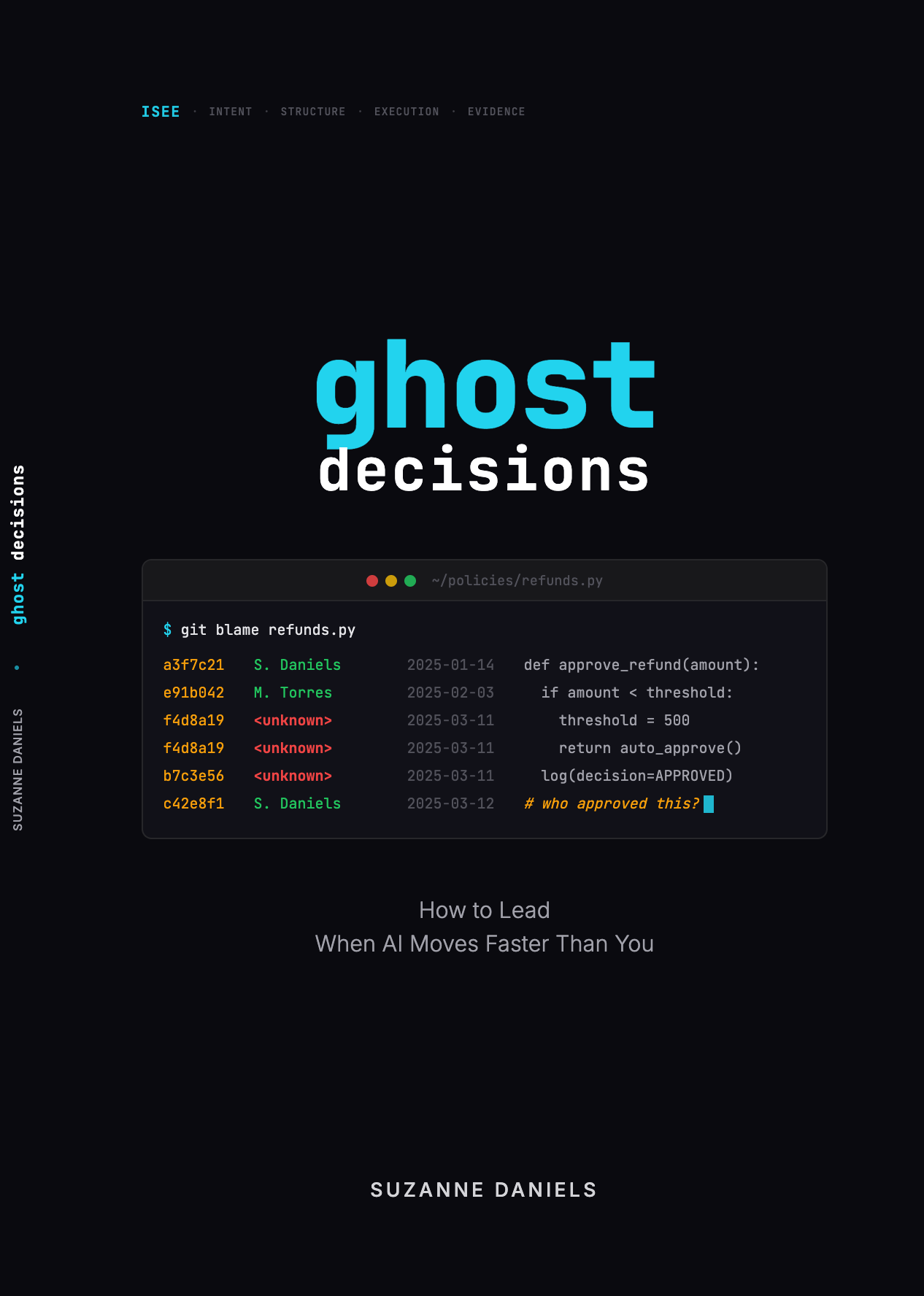
Changes that are correct, approved, deployed — and ownerless.
What happens when your operating model was built for humans and your delivery now runs at machine speed.
Intent, Structure, Execution, Evidence. Four layers, four speeds, one operating model.
Fourteen changes deployed overnight. Twelve from AI agents. All approved — by the structure, not by a person. The fix was correct. The process was followed.
And at the morning sync, nobody could say who owned the decision.
This is the Agentile condition. Most organisations are already in it. The question is no longer whether to adopt AI agents. The question is who governs what they do — and what happens when the answer is “nobody, specifically.”
ISEE is the four-layer operating model that resolves it. Humans own the slow layers — strategic intent, codified structure. Machines run the fast ones — continuous execution, real-time evidence. A spine translates between them: human judgement rendered once, enforced thousands of times per day.
It doesn't replace Agile, Team Topologies, or DORA. It addresses the layers they leave open.
If any of these sound like your week.
Your agents are merging code you didn't review.
→ Execution and Evidence — the loop that lets humans govern what they don't directly see.
Your platform team is overloaded because every decision routes through them.
→ The spine — the structural layer that lets the platform make calls without sitting in every meeting.
Your EMs are burning out and you can't say exactly why.
→ Five accountabilities hiding inside one role. Plus the three new roles that take their place.
Eight things Ghost Decisions names.
The book takes the patterns apart in eight moves.
Ghost decisions — the anatomy of a ghost decision, and where they accumulate first.
The four layers — Intent, Structure, Execution, Evidence — and why the speed asymmetry between them is the design, not a flaw.
The spine — why your platform offers a menu when it should be making the call.
The EM crisis — five accountabilities hiding inside one role, and the three new roles that replace it before it burns people out.
Rule of law — what happens when the people who held the knowledge leave, and why the spine must survive them.
Governing the governors — separation of powers for platform teams — because good people are not a governance mechanism.
The chrysalis — why transformation programmes fail, and what a real constitutional moment requires.
What ISEE does not know — open problems named without flinching, and the ones ISEE gets wrong.
The Agentile condition is not industry-specific.
It shows up first where decisions are high-stakes, multi-actor, and audited. Finance saw it first. Healthcare is next. Engineering already lives there.
An overnight rebalancing agent moved a position five basis points outside policy. The trade was profitable. The portfolio manager hadn't approved it. The compliance log says the structure did.
Three patient intake agents triaged a complaint as routine, scheduled the consult, closed the ticket. It wasn't routine. The clinical lead saw the outcome at the weekly review. Nobody could point to the moment the decision was made.
Fourteen pull requests merged between 02:00 and 05:30. Twelve from agents. CI green, deploy clean, customer happy. The on-call engineer arrives to a system that has decided things without her.
Leaders setting direction
CTOs, VPs of Engineering, CIOs, heads of platform. The book is written for the seat where the operating model gets decided.
Practitioners building the spine
Platform engineers, staff and principal ICs, EMs operating with org-design scope. They build the spine. The book gives them the vocabulary their CTO will recognise.
Advisors teaching the model
Consultants, coaches, transformation leads. Use the book to teach against the framework without simplifying it.
- Want an Agile or DevOps intro? This assumes you've lived it.
- Want a tools comparison or a “best AI coding assistant” review? This isn't that book.
- If your organisation hasn't put AI agents into delivery yet — come back when your first agent ships.

Suzanne Daniels
Spent fifteen years at the intersection of technology leadership and organisational design before building ISEE — first in the open through her Substack series Engineering Beyond Agile, then in daily practice with the senior leadership teams she advises.
Founder of Great Success, an engineering leadership practice based in the Netherlands. Chief Developer Advisor at Microsoft.
agentile.org·thesuzannedaniels.substack.com·linkedin.com/in/suzannedaniels
The book ships in June.
The essays ship weekly.
Ghost Decisions is its own artifact — 296 pages, one consolidated argument.
The ongoing thinking on engineering leadership in the AI era lives at thesuzannedaniels.substack.com.
Adjacent, not the book.